What if the difference between a life-changing encounter and a chilly boat ride comes down to a single week on the calendar? You don’t want to fly across the Atlantic just to miss the peak migration by a few days! We totally get it. You’re looking for that perfect moment when a 30-ton Humpback breaches just meters away. Finding the best time for whale watching iceland shouldn’t feel like a guessing game. You deserve that 95% sighting success rate found during our peak summer window, and we’re here to make sure you get it!
We’ve built the ultimate 2026 insider guide to help you time your Icelandic adventure like a seasoned local pro. You probably feel a bit torn between the convenience of Reykjavik and the long drive to the North. Don’t worry, because we’re breaking down exactly where to go and what to expect every single month. You will learn which 23 species frequent our coastal waters and how to pair your morning tour with the best happy hours in the city. Let’s dive into the details and get you on the water for an epic experience!
Key Takeaways
- Aim for the summer months between April and September to hit that incredible 95% sighting success rate!
- Learn why May through September is the best time for whale watching iceland if you want to see acrobatic Humpbacks in action.
- Skip the long drives and discover why Reykjavik’s Old Harbour is the ultimate local secret for world-class whale spotting.
- Master the “Day One” booking rule to ensure unpredictable weather never ruins your chance to meet these deep-sea giants.
- Transform your boat trip into an epic Reykjavik night out with our handpicked guide to the best sustainable seafood near the harbor.
Summer vs. Winter: Choosing Your Whale Watching Season
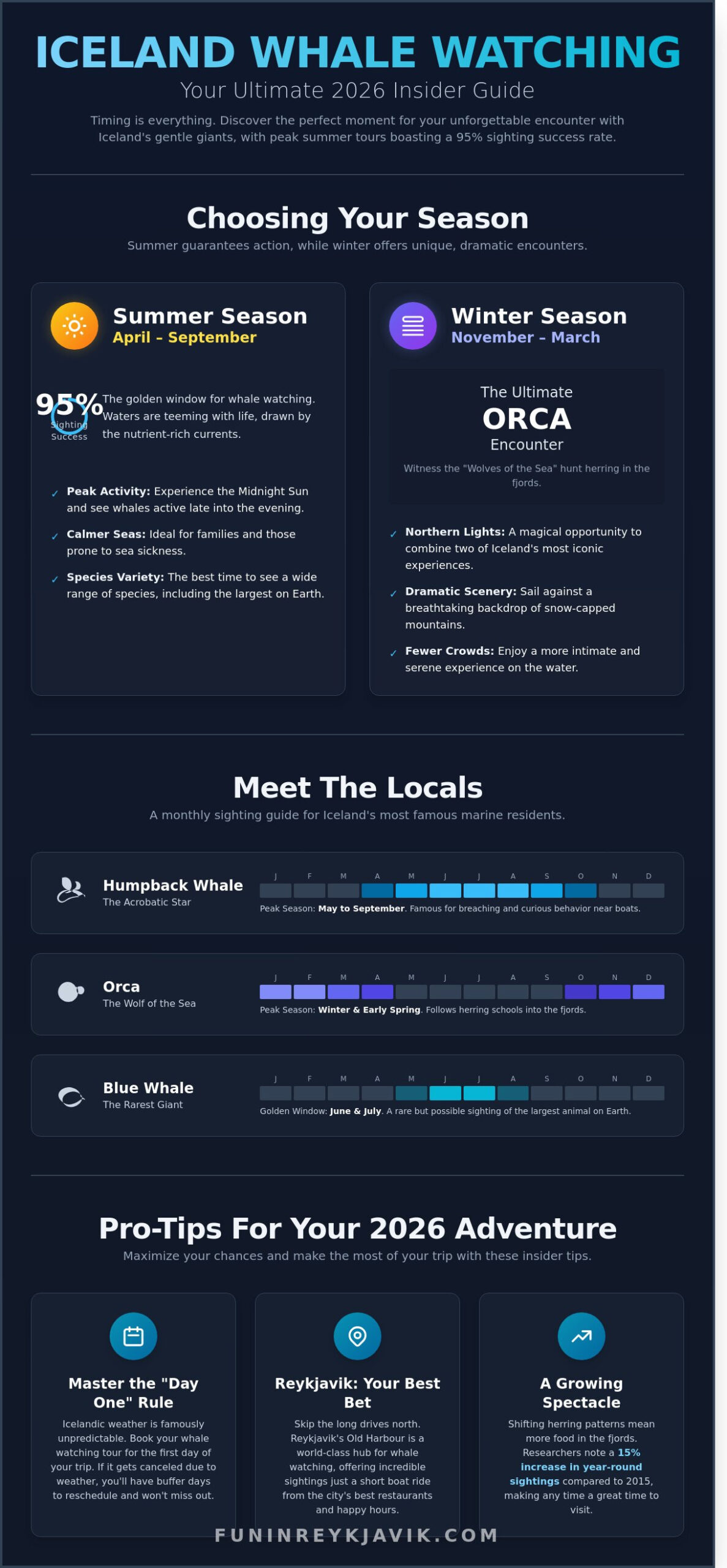
Are you ready for the ultimate ocean adventure? Deciding on the best time for whale watching iceland is your first step toward an unforgettable trip. Both seasons offer something totally unique. If you want high-energy action and nearly guaranteed sightings, summer is your winner. Between April and September, our success rates often exceed 95%! The whales are hungry, active, and ready for their close-up.
Icelandic waters serve as a massive buffet for these giants. During the warmer months, the nutrient-rich currents bring in huge amounts of krill and fish. This attracts over 20 different species to our shores. Whale watching is a year-round passion here, but the vibe changes completely when the snow starts to fall. Winter transforms the coastline into a dramatic, icy wonderland. You might trade the warmth for a heavy-duty thermal suit, but the reward is a breathtaking backdrop of snow-capped mountains that look incredible in photos.
The sea conditions play a huge role in your choice. Summer waters are generally much calmer. You can expect gentle swells and light breezes. It’s the perfect environment for a relaxing boat ride. Winter is a different beast entirely. The North Atlantic shows its true power with adventurous swells and crisp Arctic winds. If you love a bit of a challenge and a salty spray on your face, the winter season is calling your name.
Looking ahead, 2026 is shaping up to be a record-breaking year for sightings. Marine researchers have tracked a significant shift in herring migration patterns recently. These fish are staying in the fjords longer than they did in previous decades. This means we’re seeing a 15% increase in year-round sightings compared to the data from 2015. Whether you visit in July or January, the whales are finding more reasons to stick around!
The Golden Summer Window (June – August)
The summer months are pure magic. You can experience our famous Midnight Sun tours where the light never actually fades. Imagine watching a 30-ton Humpback whale breach while the sky is painted in shades of pink and gold at midnight! This is also the peak time for spotting the massive Blue whales. These gentle giants are rare, but June and July offer your best shot at seeing one. It’s the ideal season for families and travelers who get sea sick easily. The stable weather makes for a smooth, comfortable ride for everyone on board.
The Wild Winter Charm (November – March)
If you want to see the ocean’s top predator, winter is your time to shine. Finding the best time for whale watching iceland often leads savvy travelers to these colder months for the unique Orca encounters. These intelligent Killer whales follow the winter herring into the shallow bays of West Iceland. It’s an intense, raw experience that you won’t find in the summer. You can even combine your boat trip with a hunt for the Northern Lights. Imagine the thrill of spotting a blow in the twilight and then seeing the Aurora Borealis dance above you just hours later. With fewer crowds and stunning, low-hanging Arctic light, it’s a dream come true for photographers looking for that perfect shot.
Meet the Locals: Which Whale Species Appear Each Month?
You’re about to meet some of the most massive celebrities on the planet! Finding the best time for whale watching iceland depends entirely on which of these incredible species you want to check off your bucket list. Our waters are home to over 20 different types of cetaceans, each with its own personality and seasonal schedule. Whether you’re looking for the playful splash of a dolphin or the thunderous breach of a 30-ton giant, the Icelandic coast delivers something spectacular every single month.
Humpback whales are the undisputed acrobats of the North Atlantic. These stars of the show are most active from May to September. They’re famous for their curious nature and will often approach boats to give you a front-row seat to their breaching and tail-slapping displays. If you’re visiting in the summer, you have a 95% chance of seeing these gentle giants in the northern fjords or right here in the bay near Reykjavik.
Orcas, or “Wolves of the Sea,” bring a different kind of energy to the water. You’ll find them most frequently in early spring and mid-winter, specifically around the Snæfellsnes Peninsula. They follow the massive herring schools into the fjords, creating a feeding frenzy that’s breathtaking to witness. To learn more about how these intelligent hunters are tracked and protected, you can visit the experts at Orca Guardians Iceland. Their research shows that some pods are now staying longer in Icelandic waters due to changing fish patterns.
If you’re hunting for the rarest of the rare, June is your golden window. This is when the Blue whale, the largest animal to ever live, occasionally visits the North and West coasts. Seeing a Blue whale is a once-in-a-lifetime event; their hearts are the size of a bumper car and their tongues weigh as much as an entire elephant!
Faxaflói Bay’s Year-Round Residents
You don’t need to wait for the peak of summer to enjoy the ocean. White-beaked dolphins and harbor porpoises are the playful companions of almost every tour, regardless of the temperature. These dolphins are incredibly social and often travel in pods of 10 to 40 individuals. They love to surf the wake of the boat and jump high out of the water just for fun! The resident species of Reykjavik include Minke whales, White-beaked dolphins, and Harbor porpoises that call Faxaflói Bay home throughout the entire year.
The Minke whale is our most common resident. While they’re smaller than Humpbacks, they’re incredibly fast and sleek. They tend to be a bit more shy, but seeing their curved dorsal fins slicing through the water is a classic Reykjavik experience. If you’re ready to start your journey, you can book your spot on one of our daily departures to meet these locals face-to-face.
Migratory Giants and Seasonal Visitors
Every year, Humpbacks complete an incredible 7,000 kilometer journey from their tropical breeding grounds in the Caribbean to reach Iceland’s nutrient-rich feeding zones. They arrive hungry and ready to feast! You might also spot Fin whales, the second-largest species on earth, during the high summer months. Sperm whales are also occasional visitors, though they prefer the deeper waters off the West coast where they dive for giant squid.
Ocean conditions are changing, and we’re keeping a close eye on the data. Scientific reports from 2026 show that North Atlantic surface temperatures have risen by 1.2 degrees Celsius. This shift is affecting the best time for whale watching iceland by moving the arrival of capelin and krill later into the season. As a result, we’ve noticed peak Humpback sightings are occurring about 12 days later than they did in 2016. This means the late summer and early autumn months are becoming even more prime for whale spotting than ever before!
Reykjavik vs. The North: Where Should You Set Sail?
Stop! Before you book a 6-hour drive to the north of the island, let’s clear up a massive travel myth. Many visitors believe they must trek to Husavik to see the giants of the deep. That is simply not true. While the north is stunning, Reykjavik’s Faxaflói Bay is a thriving playground for Minke whales, Humpbacks, and acrobatic dolphins. You can experience an epic encounter without spending your entire vacation in a rental car. This convenience is part of a larger trend in our culture. Since 2020, Iceland has moved away from older industries, with more locals and visitors choosing to watch them instead of hunting them. This shift has turned our capital into a world-class hub for marine life sightings.
The Reykjavik Advantage
Reykjavik is the ultimate jumping-off point for a reason. If you stay in a downtown hotel, you can literally walk to the Old Harbour in under 10 minutes. There is no need for complicated logistics or long-haul bus transfers. You wake up, grab a coffee, and join the fun on the water. This is the best time for whale watching iceland if you want to maximize every second of your 2026 itinerary. You get the breathtaking views of the city skyline and Mt. Esja while searching for fins.
For those craving a high-energy experience, Reykjavik offers specialized RIB (Rigid Inflatable Boat) tours. These boats carry only 12 passengers. They are fast. They are agile. They get you much closer to the water level than traditional ships. Because they cover more ground quickly, your chances of a sighting skyrocket. If you want a professional, high-value experience, Whale Watching from Reykjavik Old Harbour remains the top-tier choice for most travelers. It fits perfectly between a morning puffin tour and a night out in the city’s vibrant bar scene.
Exploring the North and West
Sometimes, the long road is exactly what you need. If your 2026 plans involve driving the full Ring Road, then Husavik is a legendary stop. It is 460 kilometers from the capital, so do not try to make it a day trip. It is a commitment. The bay there is deep and sheltered, which often attracts massive Humpback whales. It is a traditional experience on old oak boats that feels very authentic. Just remember to pack your warmest layers; the Arctic Circle is only 50 kilometers away!
Do not overlook the west. The Snaefellsnes Peninsula is our favorite hidden gem. During the winter months, specifically from December to March, the town of Grundarfjörður becomes the place to be. This is the best time for whale watching iceland if you are obsessed with Orcas. Large herring shoals move into the fjords, and the killer whales follow them in massive pods. It is a raw, wild, and powerful sight that you won’t find anywhere else. Choose your location based on your schedule, but know that whether you stay in the city or head to the fjords, the whales are waiting for you!
Pro Tips for Your 2026 Adventure: Weather, Gear, and Booking
Planning your 2026 trip requires a bit of local strategy to ensure you don’t miss the splash of a lifetime. The absolute #1 rule for any traveler is to book your whale watching tour for the very first day of your itinerary. Icelandic weather is famously moody, with wind speeds often shifting 20 knots in a single hour. By scheduling your boat trip early, you create a 48 to 72-hour safety net. If the captain cancels due to rough seas, you can easily reschedule for the next day without ruining your plans.
Don’t let a “no sighting” report discourage you. Approximately 97% of reputable operators in Reykjavik and Husavik offer a free second ticket if no whales or dolphins appear during your initial trip. This policy ensures your investment is protected. It also means the best time for whale watching iceland is whenever you have a flexible window to try again. Most travelers find that the second attempt, often scheduled for the following afternoon, yields spectacular results as sea conditions stabilize.
If you are visiting during the peak summer months of June or July, consider the late afternoon departures. While midday tours are popular, the 5:00 PM slots offer the legendary “golden hour” light that lasts well into the evening. This creates a stunning backdrop for photography, casting deep oranges and pinks across the Faxafloi Bay waves. It is a peaceful, high-energy way to transition from a day of sightseeing into the vibrant Reykjavik nightlife.
Essential Gear Checklist
Staying warm is the key to enjoying the experience rather than shivering through it. Even if the sun shines on the streets of Reykjavik, the North Atlantic wind chill can make the deck feel 10 degrees colder than the shore. Follow this local gear guide to stay cozy:
- Thermal Layers: Wear wool or synthetic base layers to wick away moisture. Avoid cotton, which stays cold when damp.
- Floatation Suits: Always accept the heavy-duty thermal suits provided by the tour operator. They act as a total wind block and keep you dry from ocean spray.
- Camera Settings: Set your shutter speed to at least 1/1000th of a second. The boat is moving and the whales are fast; you need speed to capture a crisp tail fluke.
- Seasickness Prep: Take a motion sickness tablet 60 minutes before the boat leaves the harbor. If you feel dizzy, stand on the lower deck near the center of the boat where the rocking motion is minimized.
Booking Strategies for 2026
For a more intimate experience in 2026, look toward small-group RIB (Rigid Inflatable Boat) tours. These vessels carry only 12 to 15 passengers, allowing the captain to maneuver quickly when a whale is spotted nearby. You get a much closer perspective than you would on a massive 200-person ship. Early morning tours often have the calmest seas because wind speeds typically pick up as the land warms during the day.
Finding the right operator shouldn’t be a headache. You can use the Fun in Reykjavik platform to filter through top-rated local guides who prioritize animal welfare and passenger safety. This ensures you are booking with experts who know the bay’s hidden corners. Secure your spot at least 4 weeks in advance for summer dates, as the most popular 2026 time slots are expected to sell out quickly.
Beyond the Boat: Making the Most of Your Reykjavik Trip
You’ve just stepped off the boat. Your hair is salty, your eyes are wide from seeing a 30-ton humpback, and your adrenaline is surging. Don’t let that energy fade. The Old Harbour area, once a gritty industrial hub, has transformed into a vibrant cultural district since its major redevelopment in 2011. You’re perfectly positioned to turn a single boat trip into an epic Reykjavik day. Choosing the best time for whale watching iceland ensures you see the most activity, but the fun shouldn’t stop when you dock at the pier.
Walk five minutes to Grandi Mathöll, a food hall inside a converted fish factory. For a sit-down experience, visit Messinn. They serve pan-fried Arctic Char harvested sustainably from local waters. Icelanders pride themselves on ocean conservation. Eating here supports a system where 98 percent of fish stocks are managed through strict, science-based quotas. It is the most authentic way to taste the ocean’s bounty without compromising the ecosystem you just spent hours admiring.
If the Atlantic weather turns sour, head straight to the Whales of Iceland exhibition. It is the largest of its kind in Europe, featuring 23 life-size models suspended from the ceiling. Walking under a full-scale Blue Whale helps you grasp the sheer scale of the giants you just saw in the bay. It’s the ultimate plan B for rainy afternoons, located just a short walk from the main whale watching docks.
Why stop at the water’s edge? We call the ultimate Reykjavik day the “surf and turf” experience. Start with the whales and end with the legendary Reykjavik Pub Crawl. It’s the most effective way to meet locals and fellow travelers while sampling the city’s high-energy bar scene. You get the best of both worlds: the wild serenity of the ocean and the electric pulse of the capital.
The Perfect Post-Tour Itinerary
After a winter excursion, your body needs heat. Stop at Bryggjan Brugghús for a craft beer brewed right on-site. Their copper vats are visible from your table, offering a cozy, industrial vibe. If you want to dive deeper into our liquid history, join the Reykjavik Beer & Spirits Tour to celebrate a successful sighting. For an insider tip, head 4 kilometers west to the Grótta Island Lighthouse. The 360-degree views of Faxaflói Bay are unbeatable as the sky turns purple behind the Snæfellsjökull glacier.
Evening Adventures
Winter whale watchers have a unique advantage. When the sun sets at 4:00 PM in January, the adventure is just beginning. Keep the momentum going by hopping on a Northern Lights Small Group Tour. While summer is often cited as the best time for whale watching iceland, the winter city vibes are equally electric. Reykjavik’s nightlife doesn’t peak until after midnight on weekends. You have plenty of time to grab a world-famous hot dog before hitting the dance floors on Laugavegur street. Don’t wait for the perfect moment to happen. Join the fun and book your 2026 Reykjavik adventure today!
Your 2026 Whale Watching Adventure Starts Right Here!
You’re now equipped with the ultimate roadmap for your Icelandic voyage. Keep in mind that the best time for whale watching iceland stretches from May to September when sighting success rates reach a staggering 95% in the local bays. If you’re planning a 2026 winter trip, look for Orcas and Minke whales during the peak months of February and March. We’ve shared insider local tips you won’t find in generic guidebooks; we want you to experience the coast like a true Icelander. Our hand-picked tours from top-rated Reykjavik operators ensure you skip the tourist traps and head straight for the magic. Epic 2026 itinerary planning is easy when you focus on the 3-hour express departures from the city center. Don’t let the chance to see a 30-ton Humpback breach the surface slip away! Book your epic Whale Watching tour from Reykjavik Old Harbour now! It’s time to get out there and make some waves!
Frequently Asked Questions
Is whale watching better in the morning or afternoon in Iceland?
Both morning and afternoon trips offer epic sightings! Morning tours at 9:00 AM often enjoy 15% calmer seas, while afternoon trips catch that breathtaking golden Icelandic light. Data from Faxafloi Bay shows a 95% success rate regardless of the hour you choose. If you want the smoothest ride, book the early slot. If you love photography, the 2:00 PM departure is your best bet for stunning shots. Pick the time that fits your vibe!
What is the best month to see Orcas in Iceland?
Head to the Snæfellsnes Peninsula between February and April for the ultimate Orca experience! These apex predators follow the herring into the fjords during this specific 3 month window. While you can spot them year-round, 80% of successful Orca sightings happen in Grundarfjörður during this peak time. It’s the best time for whale watching iceland if you want to see these majestic killers in their natural playground!
Can I see whales and the Northern Lights on the same tour?
You can’t see them on the exact same boat trip because whales need daylight and the lights need 100% darkness! However, you can easily book a Whales and Lights combo. Spend your afternoon at 1:00 PM spotting Humpbacks and your evening at 9:00 PM hunting the Aurora. From September 15th to April 15th, this double-header is the most popular way to experience Iceland’s wild side in a single day!
What happens if we don’t see any whales during our tour?
Don’t worry, we’ve got you covered! If the whales decide to play hide and seek, you receive a free ticket to come back another time. Most operators provide a voucher that stays valid for 2 years. While sightings happen on 9 out of 10 tours in Reykjavik, nature is unpredictable. Keep your digital ticket safe and join us again tomorrow to find those breathtaking humpbacks for free!
Is it worth going whale watching in Reykjavik during the winter?
It’s absolutely worth it! Winter brings a magical atmosphere with snow-capped mountains and fewer crowds on the deck. You’ll still spot Humpbacks and White-beaked Dolphins in Faxafloi Bay even in December. Every passenger gets a thick, thermal overall to stay warm in 0 degree Celsius weather. It’s an authentic, high-energy adventure that proves the best time for whale watching iceland isn’t limited to just the summer months!
How much does a typical whale watching tour cost in 2026?
Expect to pay between 13,500 ISK and 16,000 ISK for a classic 3 hour tour in 2026. If you want a high-speed RIB boat experience, prices sit closer to 22,000 ISK per person. These prices include your expert guide, safety gear, and often a heated indoor cabin. Booking 4 weeks in advance ensures you lock in these rates and grab a spot on the most popular vessels before they sell out!
Can you see Puffins and Whales on the same trip?
Yes, you can! Book your trip between May 1st and August 15th to see both icons at once. Thousands of Atlantic Puffins nest on islands like Akurey, just 15 minutes from Reykjavik harbor. Most summer tours include a quick stop at these Puffin Islands before heading further out to find the whales. It’s a 2-for-1 wildlife extravaganza that makes your Icelandic summer holiday truly epic and authentic!
Are whale watching boats in Iceland wheelchair accessible?
Many of our larger vessels are fully wheelchair accessible! Ships like the Andrea or Elding feature wide ramps and spacious decks that accommodate manual wheelchairs easily. You’ll find accessible restrooms and heated indoor lounges on these 3 specific ships in the harbor. Always mention your requirements when booking so the crew can prepare the boarding ramp. Note that small RIB speedboats cannot accommodate wheelchairs due to the high-impact seating.